New study evaluates vegetation seasonal cycles in Earth system models using satellite data
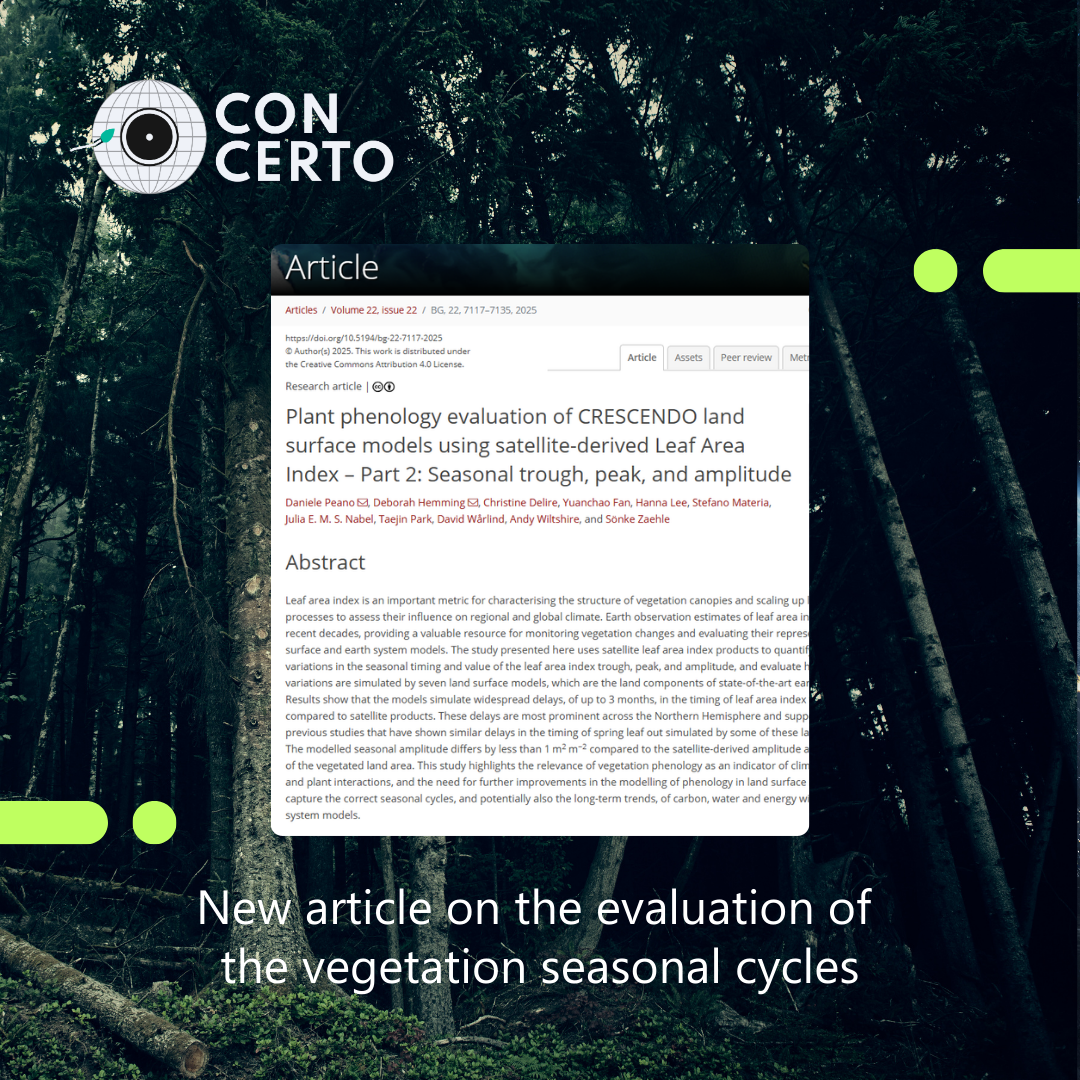
A new scientific publication highlights the importance of accurately representing vegetation seasonal cycles in land surface models used to study the Earth’s climate system. The study, titled “Plant phenology evaluation of CRESCENDO land surface models using satellite-derived Leaf Area Index – Part 2: Seasonal trough, peak, and amplitude”, has been published in the journal Biogeosciences and provides a comprehensive assessment of how well current models capture key phases of vegetation dynamics.
Led by Daniele Peano and co-authored by Deborah Hemming, Christine Delire, Yuanchao Fan, Hanna Lee, Stefano Materia, Julia E. M. S. Nabel, Taejin Park, David Wårlind, Andy Wiltshire, and Sönke Zaehle, the research evaluates the seasonal behaviour of vegetation using satellite-derived estimates of Leaf Area Index (LAI). LAI is a key indicator of vegetation canopy structure and plays a central role in scaling plant processes to the regional and global levels, influencing how ecosystems interact with climate through carbon, water, and energy exchanges.
Using satellite LAI products, the study quantifies the global patterns of three important phenological metrics: the seasonal trough, peak, and amplitude of vegetation leaf area. These observations are then compared with simulations from seven land surface models that form part of state-of-the-art Earth system models developed within the CRESCENDO framework.
The results reveal that many of the models show substantial delays in the timing of seasonal vegetation dynamics. In some regions, the simulated timing of LAI troughs and peaks occurs up to three months later than indicated by satellite observations. These discrepancies are particularly evident across the Northern Hemisphere and reinforce findings from previous research showing that some models delay the onset of spring leaf development.
By analysing vegetation phenology at regional and global scales, the research emphasises the role of seasonal plant dynamics as a sensitive indicator of interactions between climate, hydrology, soil conditions, and plant physiology. Accurate representation of these processes is essential for improving predictions of ecosystem responses to environmental change.
The findings underline the need for continued refinement of phenology processes within land surface models. Enhancing the accuracy of seasonal vegetation cycles will help ensure that Earth system models more reliably simulate the dynamics of carbon, water, and energy exchanges between the land surface and the atmosphere. Such improvements are crucial for strengthening our understanding of ecosystem responses to climate change and for supporting the development of robust climate projections.